
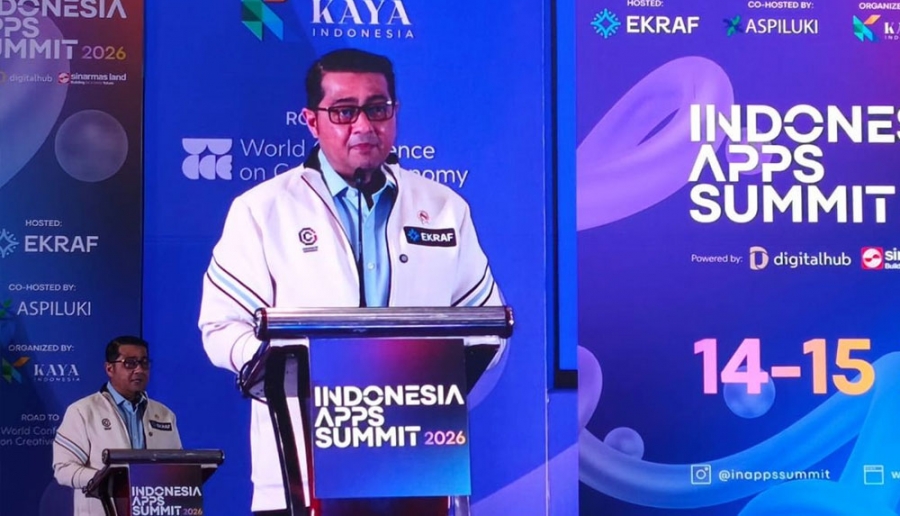
JAKARTA, KOMPAS.com – The application sub-sector emerged as the largest contributor to investment in Indonesia's creative economy throughout 2025. Its value reached IDR 54.18 trillion, representing approximately 30 percent of the total creative economy investment, which amounted to IDR 180 trillion. Minister of Creative Economy Teuku Riefky Harsya stated that total investment in the creative economy sector reached IDR 180 trillion in 2025. "The application sub-sector was the largest contributor to investment, at IDR 54.18 trillion," said Teuku Riefky during the Indonesian Application Summit (inApps) 2026 in Jakarta on Monday (September 14, 2026).
In addition to investment, the creative economy recorded an export value of US$ 31.94 billion in 2025. Teuku Riefky noted that the application sub-sector plays a vital role in the digital economy ecosystem by bringing together various economic activities on a single platform.
"Why are applications important? Because diverse digital ecosystems converge within an application. When an application grows, it is not just the company that expands, but also job opportunities, investment, and the nation's competitiveness," he said.
Creative Economy Contribution
The government has positioned the creative economy as a new source of economic growth. Currently, the creative economy contributes 7.38 percent to the Gross Domestic Product (GDP). Teuku Riefky noted that the government aims for the creative economy to achieve 8 percent growth before 2029, aligning with the economic growth target set by President Prabowo Subianto.
Expansion of Creative Economy Sub-sectors
The government is also expanding the scope of creative economy sub-sectors through the 2026–2045 Creative Economy Master Plan (Rindekraf). The number of creative economy sub-sectors has increased from 17 to 21. One of the new groups falls under "Digital and Technology Creativity," encompassing emerging technologies such as artificial intelligence (AI), blockchain, the Internet of Things (IoT), Web 3.0, big data, and cybersecurity.
"While there were previously 17 sub-sectors, there are now 21 creative economy sub-sectors," said Teuku Riefky.
The 2026–2045 Rindekraf involves 24 ministries in supporting the development of the creative economy, including at the local government level. According to Teuku Riefky, the evolution of applications is also linked to changes in the demographic structure of creative economy players.
Fifty-three percent of creative economy players belong to Gen Z and the millennial generation, while 58 percent are women. The government hopes that an increasing number of Indonesian-made applications will grow and compete in the global market.
Imagine an Indonesian child aspiring to become a doctor but possessing only one tattered book for study. Through Kompas.com’s "Ekspedisi Kata ke Nyata" (Words to Reality Expedition), you can help change that story. Let us provide access to literacy for children in remote corners of Indonesia by donating via this link: https://bit.ly/JagatLiterasi2026. Every act of kindness not only opens a window to knowledge but also unlocks their future.


